The Dutch government’s extraordinary decision to take control of Nexperia, a Chinese-owned semiconductor manufacturer based in the Netherlands, has intensified geopolitical and geoeconomic tensions in the global technology sector and underscored Europe’s growing alignment with Washington in the U.S.-China tech rivalry.
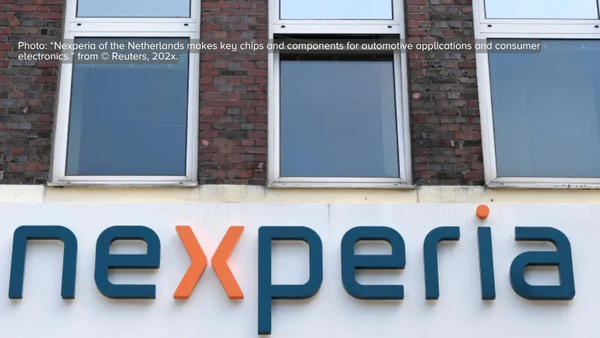
Nexperia, headquartered in Nijmegen and owned by China’s Wingtech Technology, produces high-volume chips used in automobiles, consumer electronics, and industrial equipment. Its components are considered vital to Europe’s supply chains and economic security.
Last October 12, Dutch authorities revealed they had invoked the Goods Availability Act in September to ensure that Nexperia’s chips “would remain available in an emergency,” citing national and European interests.
The rarely used law allows The Hague to intervene in private companies to secure access to critical goods. Officials said the “highly exceptional” measure was The Hague’s response to “acute signals of serious governance shortcomings and actions” that threatened the continuity of crucial technological knowledge on Dutch and European soil, particularly affecting the automotive sector.
As part of the intervention, Nexperia’s Chairman and Executive Director Zhang Xuezheng was suspended, and the company was placed under temporary external management. For the next year, Nexperia is barred from relocating assets, firing executives, or making major business decisions without explicit government approval. The company insists that its day-to-day operations will continue uninterrupted.
The controversy escalated when Nexperia’s China arm accused its European headquarters of cutting off employee pay and access to company systems—a claim Nexperia’s main office called “factually incorrect and misleading.” The company reaffirmed its commitment to its Chinese workforce and customers, stating that it had reported the incident to authorities.
The takeover comes amid tightening global export controls. U.S. officials had reportedly pressured the Dutch government to replace Zhang to exempt Nexperia from Washington’s expanded “entity list,” which restricts firms connected to Chinese entities deemed national security risks. The new American “50% rule,” implemented in late September, automatically subjects subsidiaries majority-owned by blacklisted companies, like Wingtech, to the same restrictions.
The move triggered a 10% plunge in Wingtech’s stock on the Shanghai Exchange and provoked sharp criticism from Beijing and Wingtech. In a deleted but archived WeChat post, Wingtech condemned the decision as “excessive intervention driven by geopolitical bias,” arguing that it had “strictly abided by laws in all jurisdictions” since acquiring Nexperia in 2019 and employed thousands of local workers across Europe.
In response, China imposed export restrictions on certain Nexperia-made components earlier this month, further complicating the company’s operations. The Dutch government confirmed that it is negotiating with Beijing to ease those restrictions.
The standoff reflects mounting pressure on European governments to balance economic interdependence with security concerns. The Netherlands, home to semiconductor giant ASML, has already faced Chinese backlash for curbing exports of advanced lithography machines under U.S. pressure.
The Dutch Ministry of Economic Affairs framed its intervention as a defensive act to preserve Europe’s technological sovereignty. “Losing these capabilities could pose a risk to Dutch and European economic security,” it said in a statement.
Wingtech, however, vowed to fight back through “all legal and diplomatic channels.” China’s Foreign Ministry accused the Netherlands of “politicizing economic and trade issues,” while state-run media denounced the move as “predatory” and “a blatant trampling of international rules.”
As Washington and Beijing tighten their respective restrictions, Nexperia finds itself caught in the crossfire of a geopolitical struggle that is redrawing the boundaries of global supply chains. Europe’s bid to protect its chip ecosystem may safeguard strategic autonomy but at the cost of deepening divides in the world’s already fractured semiconductor landscape.#
References:
Liu, J. (2025, October). How a Dutch chipmaker got caught up in the US-China tech war. CNN Business. https://edition.cnn.com/2025/10/15/tech/netherlands-nexperia-us-china-tech-war-intl-hnk
Ting-Fang, C. (2025, October). Nexperia, China arm at odds amid political tensions over Dutch chipmaker. Nikkei Asia. https://asia.nikkei.com/business/technology/nexperia-china-arm-at-odds-amid-political-tensions-over-dutch-chipmaker
Shamim, S. (2025, October). Why has Dutch government taken control of China-owned chipmaker Nexperia?. Aljazeera. https://www.aljazeera.com/news/2025/10/14/why-has-dutch-government-taken-control-of-china-owned-chipmaker-nexperia