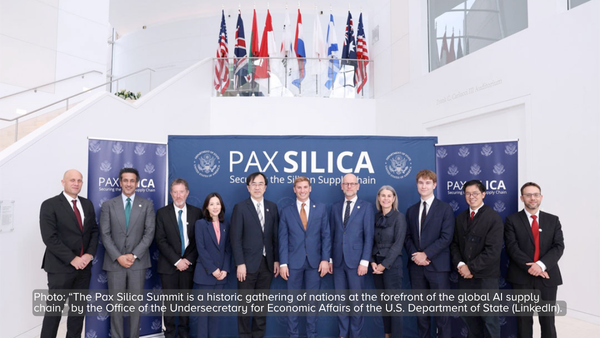
The United States Secretary of State for Economic Affairs announced on April 16 the U.S. and the Philippines’ Plan to initiate a 4,000-acre Economic Security Zone under the Pax Silica Initiative, which rallies U.S. allies and economies towards its economic and security agenda. The Zone will be in the Luzon Economic Corridor of the Philippines, with the New Clark City declared as the next AI-hub, for increasing the production of inputs needed in U.S. supply chains.
The Pax Silica particularly plans to tap critical minerals of the country such as nickel, copper, chromite, and cobalt. These minerals are vital to the production of high-end chips, and high-capacity batteries, that are both used for commercial and military purposes. The Initiative is consistent with the U.S. strategy of “re-shoring and friend-shoring” production of semiconductors, as part of de-risking its supply chain, particularly, from China.
Pax Silica aims for an overall expansion of military-building capabilities, strategically positioned in the Asia-Pacific. The expansion of assembly-test-packaging operations of U.S. chips production in the Zone could employ thousands of workers, relying on more than 40 years of semiconductor industrial footprint in the country. “Friend-shoring” ATP operations to the U.S. allies, such as the Philippines, avoids disruptions in the U.S. supply chains and solves its logistical problems in positioning its assets in the Pacific. It does not intend to advance the level of technological capabilities of the domestic workforce, keeping the role of the Philippines at the backend of the ATP segment of the semiconductor supply chain. Development of infrastructure such as railways and road networks primarily serves the purposes of the Zone.
One of Pax Silica’s features is its “Enhanced Operational Certainty” which pertains to an “enhanced access” to the Philippine workforce, energy and mineral resources, and strategic posts in the Indo-Pacific region, through “internationally enforced contracts.” This could mean an overriding of existing laws, regulations and standards, including labor standards that protect workers’ rights and welfare. A “joint governance” between the US and the Philippines also undermines Philippine sovereignty and jurisdiction over its territories, reminiscent of the country’s experience with the U.S. military bases. Setting up facilities for the manufacture, storage and logistical routes of war materiel for the purposes of the U.S., is also a violation of the Philippine Constitutional ban on foreign military bases.
While Pax Silica lays out the plan for setting up an Economic Security Zone in the Philippines, it must be recalled that the Philippines is also part of the Partnership for Indo-Pacific Industrial Resilience (PIPIR). The PIPIR, now including 16 countries, is centered on the collaboration of U.S. and its allies to produce missile motors, drones, and ammunition. The U.S. is particularly looking into an ammunition production line in the Philippines, with a new facility to assemble and package 30mm cannon rounds.
According to the U.S. National Security Law Team, this “industrial collaboration” is legally grounded on the 1951 US-RP Mutual Defense Treaty, to solve logistical challenges for the U.S. and supposedly provide the Philippines with “defense assets” for the protection of its sovereignty.
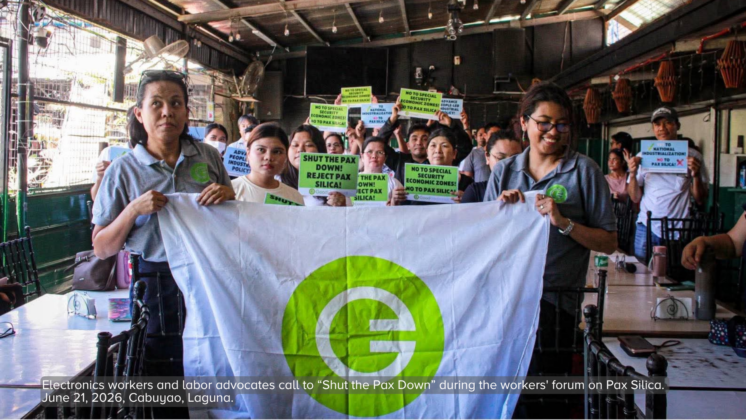
With Pax Silica, the Marcos Jr. Administration allows the country to become an instrument and a staging ground for the U.S. wars, while it surrenders national sovereignty, including the country’s jurisdiction over its territories, and national patrimony, when it allows foreign entities to exploit minerals from Philippine land. It also exposes the Filipino workers to further exploitation, when labor regulations and international labor standards are overridden in “contracts,” and domestic agencies lose authority and oversight over the workers and the workplaces inside the Zone.
The Filipino people and workers should oppose the U.S. wars and Pax Silica. The Marcos Jr. Administration is dragging the country to war, at the same time, it surrenders Philippine sovereignty and patrimony, primarily to the benefit of the United States. Industrial development cannot be borne out of an Initiative that merely transfers backend operations, and foregoes development of genuine, worker-led industries, the enhancement of talent and technology, and the protection of workers’ rights and welfare.