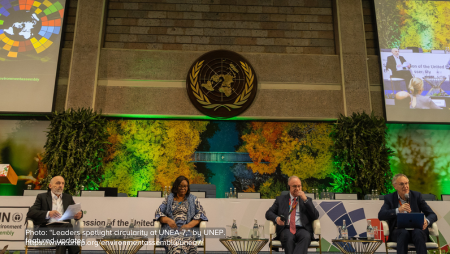
The recent call by UN Secretary-General António Guterres for “just and equitable” mineral supply chains and a fair energy transition rings loud and necessary. However, the Centre for Research on Multinational Corporations – SOMO) points out in its latest critique that urgency and ambition alone won’t bring justice.
While the UN’s report rightly points to the need for climate finance, just transition measures, and better governance of transition minerals, it falls short of naming and challenging the forces driving the crisis: overconsumption, high dependence on fossil fuels, and extractive economic models.
The fundamental issue, as SOMO researchers assert, is that we are not transitioning away from fossil fuels — we’re still expanding. Since 2015, global fossil fuel supply has increased by 12%, and while renewable energy has grown, it merely adds to the global energy mix and doesn’t replace fossil fuels. Renewables now account for only 15% of the global energy supply, leaving the majority of demand still served by oil, coal, and gas.
The structural model of endless growth and extraction remains intact, added SOMO. This is evident in how fossil fuel subsidies hit $620 billion in 2023, outpacing support for clean energy by nearly a factor of ten. Moreover, trade and investment rules — particularly Investor-State Dispute Settlement (ISDS) mechanisms — continue to shield fossil fuel companies from regulation.
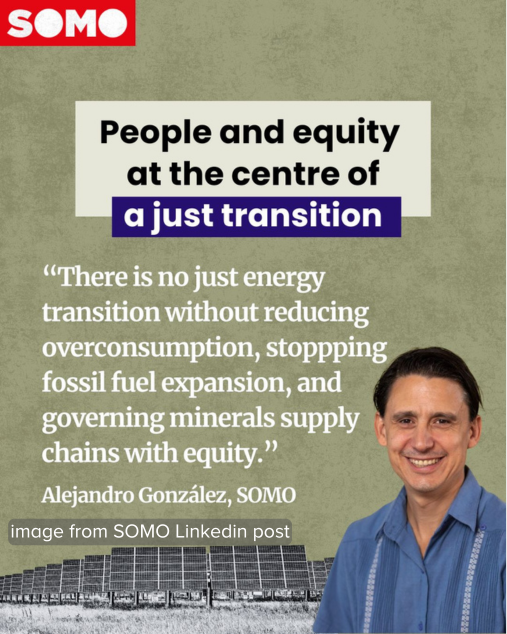
As Alejandro Gonzalez of SOMO puts it, unless we confront these root issues, the so-called “energy transition” may simply reproduce the same extractive systems that caused the climate crisis to begin with. Read Alejandro’s post here.
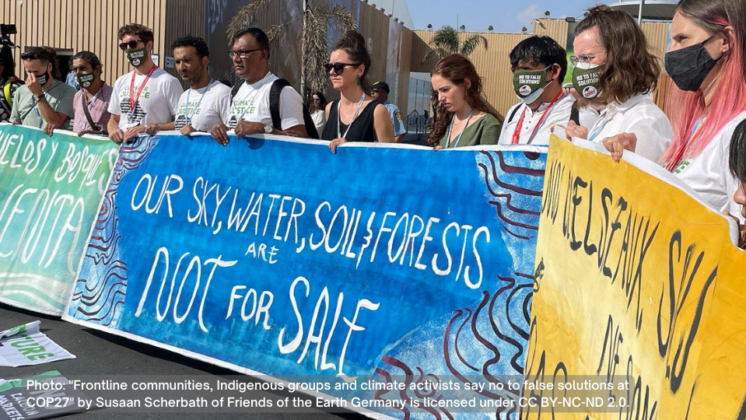
What we need isn’t just a faster transition — but a different kind of transition altogether. One grounded in justice. A just transition that genuinely shifts direction and redistributes power. This means:
- Reducing material and energy use, especially in overconsuming industrial economies;
- Dismantling ISDS and rewriting trade rules that prioritize corporate rights over environmental and human rights;
- Ending fossil fuel expansion and subsidies;
- Ensuring democratic, just governance of mineral supply chains, putting the needs and rights of communities at the center.
SOMO’s call: climate justice cannot be achieved through market-based fixes or shallow reforms. The energy transition must not be just a new chapter in corporate profit-making — it must be a transformative moment, one where people, not profits, define the future.
Read the full United Nations report: https://lnkd.in/eb7T8-BR
Read SOMO’s original post here.