The GoodElectronics Network, Asian Network for the Rights of Occupational and Environmental Victims (ANROEV), and the Institute for Occupational Health and Safety Development (IOHSAD), together with the Asia Monitor Resource Centre (AMRC), and the Solidarity Center, hosted RE+Act → Rights, Empowerment & Action: Skills Sharing Capacity Session on OSH and Chemical Safety Rights last September 13–14, in Manila.
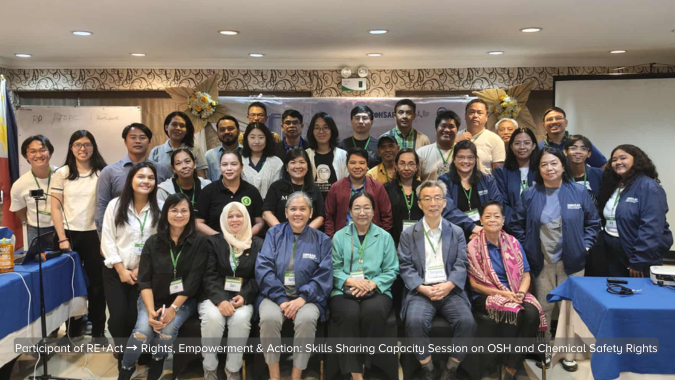
The Event
The two-day gathering brought together labor rights advocates, victims’ groups, union leaders, and occupational health experts from across Asia. With interactive sessions, case presentations, and workshops, participants deepened their knowledge of hazardous chemicals, strengthened advocacy skills, and developed concrete campaign strategies to advance occupational safety and health (OSH) rights.
Key discussions included the global campaign for chemical safety, implications of the US-China tech war on Asia’s semiconductor sector, and the need to ratify ILO Convention 170 on chemical safety. The event also highlighted the adoption of a Global Framework on Chemicals and what it means for workers’ rights worldwide.
The Electronics Industry Situation
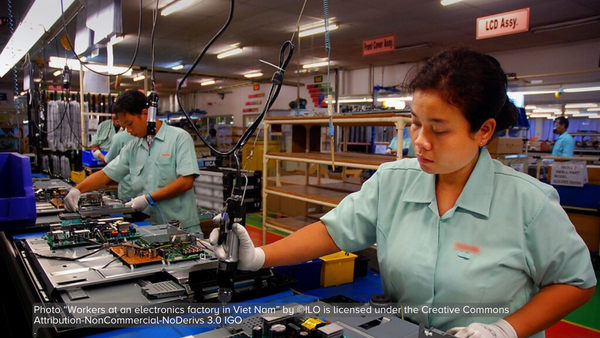
Electronics production continues to drive economies across Asia, employing millions in sprawling global supply chains. Yet, behind its rapid growth lies the unchecked use of toxic chemicals. In countries where regulations are weak and enforcement is lacking, workers face daily exposure to carcinogens, solvents, and heavy metals linked to chronic illnesses, reproductive harm, and even death.
These dangers are not confined to electronics alone—similar risks threaten workers in garments, agriculture, and chemical industries, where occupational health protections remain under attack.
Victims’ Stories
One of the most powerful moments of the session was the sharing of testimonies from victims and families. Representatives from South Korea’s SHARPS, Taiwan’s TAVOI, Thailand’s WEPT and TLSF, and the Philippines’ IOHSAD recounted stories of workers who developed cancer, respiratory illnesses, and other life-threatening conditions after years of chemical exposure.
Victims and advocates from TAVOI (Korea) said, “Our bodies are our only evidence,” reflecting the irreversible harm of chemical exposure and the lack of pre-production safety studies in rapidly changing semiconductor processes.
The documentary “Colorless, Odorless” by Korean filmmaker Lee Eunhee, also screened during the session, offered a haunting portrait of the invisible hazards in semiconductor production and the lives affected. These narratives underscored the urgency of treating chemical safety as a fundamental human right.
Activity Highlights: Voices from the Training
The session was rich with insights from speakers, victims, and advocates:
- Graczyk Halshka (ILO Headquarters) emphasized that while ILO Convention 170 provides essential guidelines to protect workers, many countries have not ratified it, and even those who have often failed to implement it effectively.
- Rory O’Neill (ITUC) reminded participants that “information is information and power is power. It is not enough to have information. We must organize ourselves to have the power to change.” He noted how current political developments threaten global labor standards, highlighting attempts to weaken chemical protections.
- Dr. Domyung Paek (ANROEV Chairperson) highlighted the gap between receiving knowledge and embodying knowledge, urging participants to make solidarity actionable.
- From Thailand, advocates underscored the need to arouse, organize, and mobilize, reminding that workers often endure injustices and low wages simply because they are uninformed of their rights.
- Lion Indonesia shared their work on asbestos campaigns: identifying victims, documenting cases, and pursuing legal action up to the Supreme Court.
- Lennon Ying-Dah Wong (SPA-Taiwan) stressed the vulnerability of migrant workers and the importance of documenting abuses while helping them unionize.
- Julius Carandang (MWAP, Philippines) pushed for campaigns that go beyond factory walls, targeting multinational companies and uniting movements across industries.
- Participants also shared ongoing challenges: from inadequate or recycled PPE in Korea and Taiwan, to laws used against workers in Indonesia, and the difficulty of prosecuting violators in the Philippines, where many cases are dismissed despite clear evidence of violations.
Across all discussions, a common theme emerged: workers are treated as disposable tools for production, and OSH remains one of the least prioritized aspects of labor rights—despite its life-and-death consequences.
Resolutions and Next Steps
On the second day, participants engaged in breakout workshops and strategy-building sessions to draft national and regional campaign plans. Among the key resolutions were:
- Strengthen campaigns for the ratification of ILO Convention 170 on chemical safety.
- Coordinate regional advocacy to push governments for stricter OSH regulations and enforcement.
- Document chemical-related OSH violations and amplifying victims’ voices in national and global forums.
- Develop a unified network strategy for engagement with the Global Framework on Chemicals.
- In addition, participants were requested to issue an Amicus Curiae Support in a Strategic Lawsuit Against Public Participation (SLAPP) case in Indonesia to show solidarity against legal harassment of labor and environmental defenders.
The session closed with renewed commitment from all networks to advance workers’ health and rights, affirming that the fight against toxic workplaces is also a fight for dignity, justice, and life. #