Electronics workers and labor advocates call to Reject Pax Silica during the workers’ discussion organized by GoodElectronics Network and the Metal Workers Alliance of the Philippines (MWAP) in Cabuyao, Laguna. June 21, 2026.
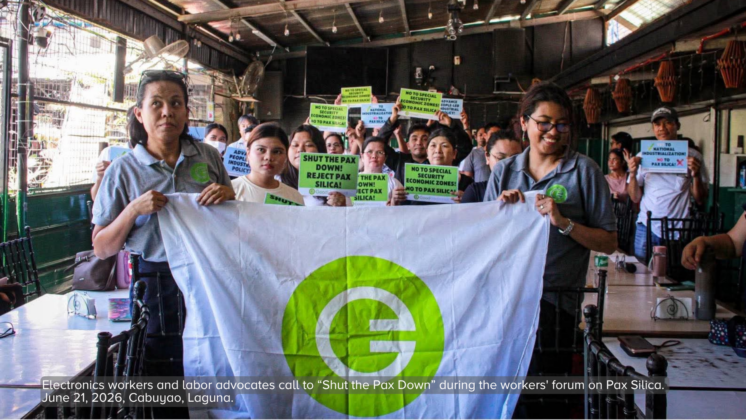
On 21 June 2026, the GoodElectronics Network, in partnership with the Metal Workers Alliance of the Philippines (MWAP), convened a workers’ discussion titled “Pax Silica: Zoning for War, Plunder and Exploitation” in Cabuyao, Laguna. The forum brought together electronics workers and allied organizations from the Southern Tagalog region to examine the implications of the recently announced Pax Silica initiative and the proposed Economic Security Zone (ESZ) within the Luzon Economic Corridor.
The discussion was organized in response to the United States’ announcement of a 4,000-acre ESZ under Pax Silica, a strategy aimed at securing semiconductor supply chains, artificial intelligence infrastructure, critical minerals, and other strategic industries among US allies. Participants explored what these developments could mean for workers, communities, the environment, and the proposed path of industrial development by the US-led initiative.
The program opened with an introduction to the GoodElectronics Network by Rochelle Porras, who situated the discussion within the network’s global campaign. She emphasized the importance of understanding emerging developments in the electronics industry and strengthening international solidarity among workers facing rapid changes in global production networks.

Gene Rodriguez delivered the session “Pax Silica: What Workers in the Electronics Industry Must Know,”placing the initiative within the broader context of the global AI race and the semiconductor competition between the United States and China. Her presentation examined the political, economic, labor, and environmental dimensions of Pax Silica, including the expansion of semiconductor manufacturing, critical mineral extraction, and AI data center infrastructure in the Philippines. She also discussed the growing role of semiconductors in military production and encouraged participants to reflect on what genuine national industrialization would look like from the perspective of Filipino workers.
In the afternoon session, Eleanor de Guzman discussed recent US industrial and security policies related to semiconductors and strategic supply chains, explaining how reshoring and friend-shoring initiatives are reshaping global production. She also identified key projects under the Luzon Economic Corridor and encouraged participants to map industries, corporations, and government agencies involved in the implementation of Pax Silica to support future workplace education and advocacy initiatives.

The open forum generated active discussion among participants, particularly on the projected impacts of AI data centers, critical mineral mining, and expanding energy infrastructure. Workers raised concerns about the significant electricity and water requirements of data centers, the environmental impacts of mining and large-scale infrastructure projects, and the implications of these developments for surrounding communities amidst worsening labor conditions.
The forum concluded by reaffirming the need for continued worker education, research, and organizing on the impacts of Pax Silica. Participants emphasized the importance of advancing an alternative vision of industrial development that prioritizes domestic interests and upholds workers’ rights, environmental sustainability, and national sovereignty.
Download the presentation here.